

Why A Pest Control Referral Network is the Right Choice for Companies With Overflow Leads They Can’t Work
SHARE


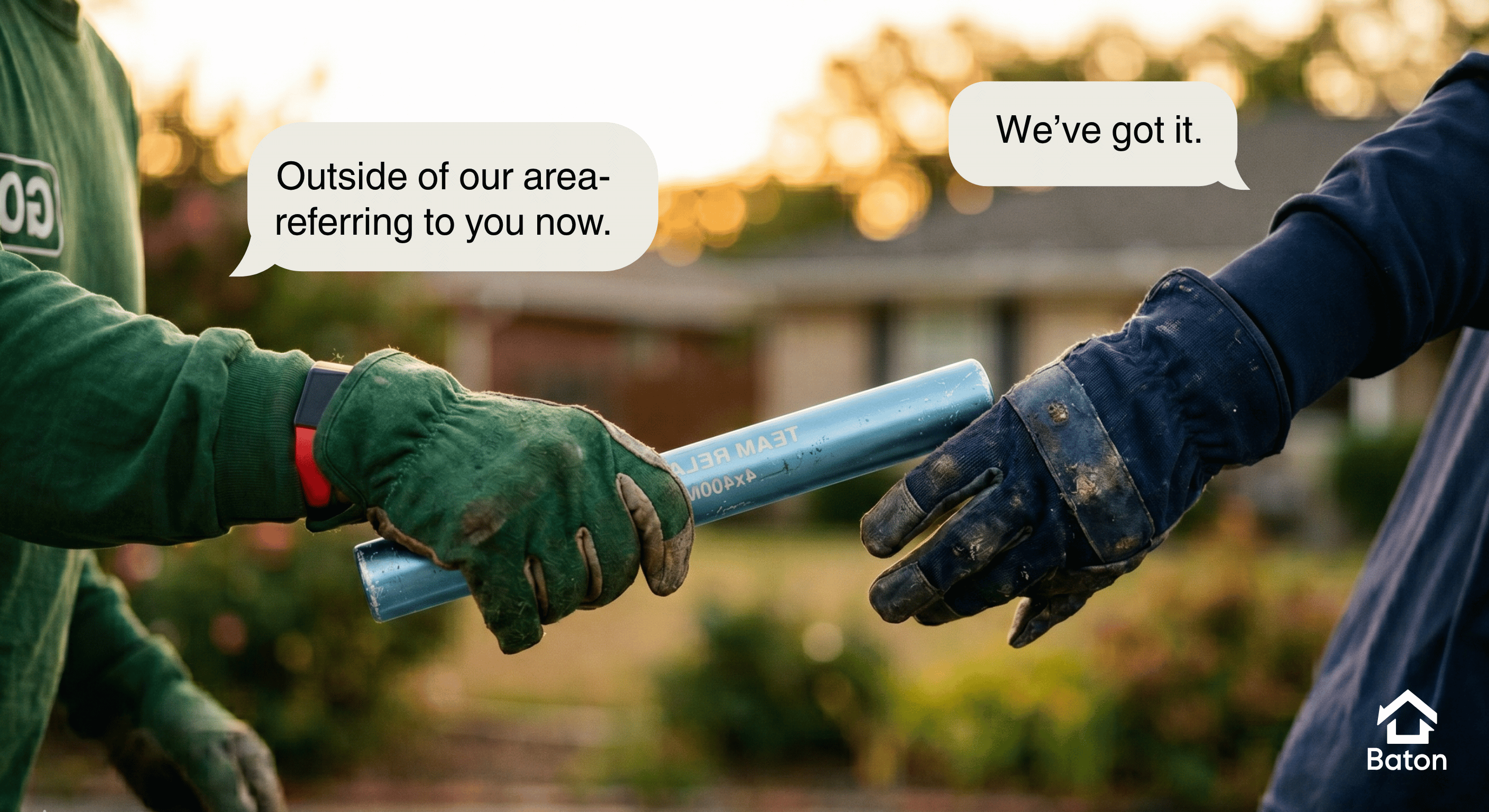
As a pest control operator with locations across multiple markets, your marketing budget likely sends hundreds or thousands of leads each week to your sales team.
And yet, every week, your team is telling potential customers "sorry, we can't help you."
Wrong service area. Wrong pest type. Fully booked. Specialty job you don't handle.
Baton’s internal data shows that large pest control providers receive 100-300 calls each week that they are not able to work. Each one of those calls represents a real customer with a real problem, and real revenue that just walked out the door. If you’re a pest control operator and you’re not monetizing calls that you can’t work, this post is for you.
Why monetizing leads you can’t work is so important
Here's a simple way to think about it. If your company turns away even 20 calls a week — which, for a multi-location operator, is conservative — and your average job ticket is $350, that's $7,000 in potential revenue gone every week. $364,000 a year. Not because you weren’t able to win the job, but because you couldn’t take it when it came in.
For most pest control companies, this isn't a hypothetical. It's a regular occurrence. Peak season means capacity constraints. Geographic expansion means edge-of-service-area calls you can't take. Specialty wildlife jobs require operators you might not have on staff in every market.
That’s why Baton built our pest control referral network - to allow operators to benefit from overflow pest control leads that they are not able to work.
In the table below, you can see how referring your unworked leads and using the revenue generated from those referrals can help you win more jobs in the future and generate profit from what would have otherwise been a total loss. By reinvesting the payouts you earn from referring jobs you can’t work into Baton’s platform, you can receive high-intent pest control leads that convert to revenue and still generate profit even from jobs you don’t work.
Saying no to jobs is more expensive than it looks. Besides the cost of the job itself, there are two more costs that don't show up in your reporting.
The first is customer trust. When a homeowner calls you and you can't help them, they remember. If you can't even help them find someone who can take the job, you've ended the relationship before it started. In a business built on recurring service and word of mouth, that's a compounding loss.
The second is team morale. Your sales reps and dispatchers are trained to book jobs. Turning away calls repeatedly — especially during peak season — creates friction and frustration.
How to monetize pest control leads you can’t accept
The fastest-growing pest control companies monetize that overflow. Instead of letting those calls die, they route them to vetted operators in adjacent markets or specialty niches who can actually service the customer. And they get paid for it.
Baton’s referral network is a two-sided exchange: you refer the calls you can't take and earn revenue on each one. You also receive high-intent referrals from other operators in the network when they're in the same position.
If you’re wondering whether or not Baton could be a good fit for your pest business, you should ask two questions this week
First: how many calls did we turn away last month, and what was the total ticket value of those jobs?
Second: do we have a systematic way to monetize those calls, or are we just letting that revenue disappear?
f you don't have a clean answer to both, it's worth understanding what a referral network can do for an operation your size.
Baton connects vetted pest control and wildlife removal companies across the country. Partners set their own service areas, job types, and price per lead. There's no long-term commitment to start.
See what you could earn, and refer your first lead, at batonleads.com.
Want to hear more? Listen to how Baton is revolutionizing referrals for pest control.
You may also like




Subscription successful! Stay tuned for the latest from Baton Referrals.
Oops! Something went wrong while submitting the form.
